The Pastoral Retirement Crisis: Why Too Many Pastors Are
Reaching the End of Ministry Unprepared
For decades, pastors have stood in the gap for other people.
They have prayed for families, comforted the grieving, counselled couples, baptized children, buried loved ones, preached through difficult seasons, and carried the weight of their congregations on their shoulders.
But there is one question many pastors quietly postpone:
“What happens to me when my ministry income stops?”
It is a question that often comes much later than it should.
And for some pastors, retirement arrives before the answer is ready.
This is the pastoral retirement crisis hiding in plain sight.
It isn't simply a financial problem. It is a planning problem, a transition problem, a family problem, and, sometimes, an identity problem.
And the good news is this:
It is a problem that can be addressed.
The Question Many Pastors Are Afraid to Ask
When I talk about retirement planning for pastors, I often remind people that preparing for retirement is not an admission that you have stopped trusting God.
Quite the opposite.
Faith and preparation can work together.
A pastor can believe that God is his provider while also understanding the importance of saving, investing wisely, creating additional income streams, planning for healthcare, and preparing for life beyond the pulpit.
The real danger is not planning.
The real danger is waiting until there is no time left to plan.
For many clergy, retirement can expose financial vulnerabilities that have been building quietly for years: irregular income, limited pension benefits, insufficient savings, ministry expenses that spill into personal finances, uncertain healthcare arrangements, and little preparation for replacing pastoral income.
The original article identifies these same pressures—including the reality that personal savings can repeatedly take second place to congregational needs.
And this is where we need to have a different conversation about retirement planning for pastors.
Pastors Give So Much—But Who Is Planning for Their Future?
Pastoral ministry is a calling.
But a calling does not eliminate financial responsibilities.
In fact, years of faithful service make thoughtful retirement planning even more important.
Many pastors have spent decades putting their families, churches, communities, and congregations first.
They have given generously.
They have lived sacrificially.
They have answered emergency calls at midnight.
They have travelled when there was no extra money in the budget.
They have counselled people through financial crises while quietly wondering about their own financial future.
And sometimes, somewhere along the way, retirement planning gets pushed to the bottom of the list.
“There's still time.”
“I'll deal with it next year.”
“The church will take care of me.”
“God will provide.”
But retirement planning requires more than hope.
It requires a plan.
And creating that plan doesn't mean compromising your calling.
It means protecting the life and family you have worked so faithfully to build.
Retirement Is More Than Leaving the Pulpit
One of the biggest misconceptions about pastoral retirement is that it is simply a financial event.
It isn't.
Retirement from ministry can affect almost every area of a pastor's life.
Your income may change.
Your housing situation may change.
Your daily routine may change.
Your relationships may change.
Your responsibilities may change.
And perhaps most importantly, your sense of identity may change.
For years, people may have called you Pastor.
People knew where to find you.
They knew your role.
They knew your purpose.
Then one day, the title may no longer define your daily life.
And a question can quietly emerge:
“Who am I if I am no longer standing behind the pulpit?”
That question deserves as much attention as, “How much money do I need to retire?”
The original article rightly highlights identity as one of the often-overlooked dimensions of pastoral retirement planning.
This is why I believe retirement preparation for pastors must address the whole person, not just the pension or investment account.
The Four Conversations Every Pastor Should Have Before Retirement
A healthy pastoral retirement plan should begin long before the final sermon.
There are four important conversations every pastor should consider.
1. The Financial Conversation
How much will you need to live comfortably?
What income will replace your pastoral salary?
Do you have retirement savings?
Will you have pension income?
What happens if your church-provided housing ends?
What will healthcare cost?
Do you have other sources of income?
These questions may feel uncomfortable.
Ask them anyway.
Because financial clarity creates options.
And options create peace.
2. The Income Conversation
Your retirement plan should not necessarily depend on one source of income.
For some pastors, the answer may involve building multiple income streams before leaving full-time ministry.
That could include writing, teaching, consulting, mentoring, speaking, digital products, online education, investments, or other forms of income that align with the pastor's skills, experience, values, and available time.
The goal isn't to turn every pastor into an entrepreneur.
The goal is to create sustainable income that supports life after active ministry.
This is one of the principles behind my approach to pastoral retirement coaching: helping pastors explore three to five sustainable income streams without assuming they need to build a conventional business.
3. The Legacy Conversation
What will you leave behind?
Not simply financially.
What wisdom will you pass on?
Who will carry the vision?
Have you prepared the next generation?
Have you documented important institutional knowledge?
Have you thought about your estate?
Have you talked with your spouse and family about what happens next?
Retirement should not mean disappearing.
It can become a season of transferring wisdom.
There is a beautiful opportunity for a retiring pastor to move from building the ministry to building the people who will carry it forward.
4. The Purpose Conversation
Perhaps the most important question is:
“What will I do with my days?”
A pastor may retire from a position without retiring from purpose.
Your experience still matters.
Your wisdom still matters.
Your voice still matters.
Your relationships still matter.
You may discover opportunities to mentor younger pastors, write books, teach, coach, consult, speak, serve in community organizations, support missions, take on interim ministry assignments, or simply spend meaningful time with your family.
Retirement can be an ending.
But it can also be a beginning.
And Please Don't Leave Your Spouse Out of the Conversation
There is another person who often carries the quiet weight of pastoral retirement:
the pastor's spouse.
When a pastor retires, the spouse retires too—from a lifestyle, a community, familiar relationships, expectations, and sometimes housing arrangements.
The financial decisions affect both people.
The emotional transition affects both people.
The question of what comes next affects both people.
That is why retirement planning for pastors should never be a conversation that happens with the pastor alone.
Sit down together.
Talk about money.
Talk about housing.
Talk about healthcare.
Talk about where you want to live.
Talk about what you want your days to look like.
Talk about what you are excited about.
And talk about what you are afraid of.
Sometimes the most important retirement planning conversation is not about numbers at all.
It is simply:
“What do we want our life to look like after the pulpit?”
Starting Late Doesn't Mean Starting Is Pointless
Perhaps you are reading this at 55.
Or 60.
Or 65.
And you're thinking:
“I should have started years ago.”
Maybe you should have.
But regret will not fund your retirement.
Action might.
The most important thing you can do is stop looking backward and start looking honestly at where you are today.
Assess your current financial position.
Identify your income sources.
Understand your expenses.
Calculate your retirement gap.
Look at your assets and liabilities.
Explore potential additional income streams.
Review your healthcare and insurance needs.
Discuss your plans with your spouse.
Then create a practical roadmap for the years ahead.
You don't have to solve everything in one afternoon.
But you do need to start.
Retirement Planning Is Not a Lack of Faith
Let me say this clearly because I know the conversation can sometimes feel uncomfortable within Christian communities:
Planning for retirement does not mean you don't trust God.
Noah built the ark before the rain.
Joseph prepared Egypt before the famine.
Proverbs reminds us of the wisdom of leaving an inheritance for future generations.
Preparation and faith are not enemies.
They can be partners.
The goal isn't to put your trust in money.
The goal is to use wisdom with the resources God has placed in your hands.
A pastor who prepares for retirement isn't abandoning faith.
He or she is taking responsibility for the next season.
Life Beyond the Pulpit Is Worth Preparing For
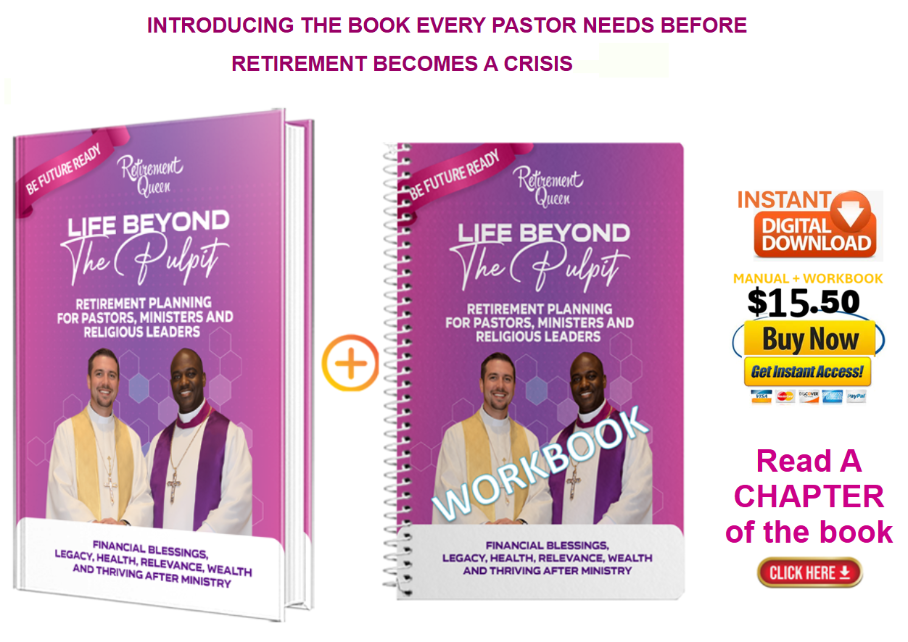
This is the reason I wrote Life Beyond the Pulpit.
I wanted to create something that speaks directly to pastors—not generic retirement advice adapted for clergy, but a conversation that understands the unique financial, emotional, family, identity, and purpose questions that can come with leaving active ministry.
The book explores practical questions such as:
- How do I know whether I am financially ready for retirement?
- How can I create income beyond my pastoral salary?
- What can I do if I started saving late?
- How do I prepare for life after the pulpit?
- What happens to my identity when my pastoral role changes?
- How do I prepare my family and spouse?
- How can I think about legacy and estate planning?
- How can I transition from ministry without feeling like I have lost my purpose?
These are not merely retirement questions.
They are life questions.
And they deserve honest answers.
Your Calling Doesn't End at Retirement
One of the things I want every pastor to understand is this:
Retirement is not the retirement of your calling.
It may simply be a change in how you express it.
You may preach less and mentor more.
You may lead less and write more.
You may stand behind the pulpit less and sit across the table with younger leaders more.
You may discover gifts you never had time to develop during active ministry.
There can be life after the pulpit.
There can be purpose after the position.
There can be income after the salary.
There can be joy after the transition.
But preparation matters.
Don't Wait for Retirement to Force the Conversation
If retirement is ten years away, start now.
If it is five years away, start now.
If it is one year away, start now.
And if you are already retired and wondering whether you got it right, start where you are.
The goal isn't perfection.
The goal is preparedness.
Your years of service matter.
Your family matters.
Your future matters.
And the season beyond the pulpit deserves the same intentionality you brought to the years you spent serving others.
You have spent years preparing sermons, preparing leaders, preparing families, and preparing people for their futures.
Now it may be time to prepare for yours.
Life Beyond the Pulpit Starts With a Plan
If you are a pastor approaching retirement—or a spouse quietly wondering what retirement will look like for your family—Life Beyond the Pulpit was written to help you begin that conversation.
You don't have to have all the answers before you begin.
You simply need to be willing to ask the right questions.
Because retirement should not be a season of fear, lack, or uncertainty after a lifetime of faithful service.
It can be a season of peace, purpose, provision, and possibility.
And yes, there really can be a fulfilling Life Beyond the Pulpit.
— Bibi
Apampa
The Retirement Queen
Frequently Asked Questions About Pastoral Retirement Planning
1. Why is retirement planning important for pastors?
Retirement planning is important for pastors because ministry income, pension benefits, housing arrangements, healthcare, and personal savings can look very different from those of a traditional employee. A thoughtful pastoral retirement plan helps you understand what you will need financially and how you can create a stable and purposeful life after active ministry.
2. When should a pastor start planning for retirement?
The best time to start retirement planning is as early as possible. However, it is never too late to begin. Whether retirement is ten years away, five years away, or just around the corner, the first step is to understand your current financial position and create a practical plan for the years ahead.
3. What makes retirement planning for pastors different?
Pastoral retirement planning needs to consider the unique circumstances of clergy, including irregular income, church-provided housing, denominational benefits, limited pension arrangements, ministry-related expenses, and the emotional transition away from the pulpit. A pastor's retirement plan should address both financial security and life beyond the pastoral role.
4. How much money does a pastor need to retire?
There is no single retirement number that works for every pastor. Your retirement needs depend on your desired lifestyle, housing costs, healthcare, debt, family responsibilities, existing savings, pension or other benefits, and potential income sources. The first step is to calculate your expected retirement expenses and compare them with your projected retirement income.
5. What can pastors do if they have little or no retirement savings?
Don't panic—and don't give up.
Start by assessing where you are today. Look at your income, expenses, assets, debts, and available retirement benefits. Then identify opportunities to increase savings, reduce unnecessary expenses, and develop additional income streams. Starting late may require a more focused strategy, but late is still better than never.
6. Can pastors create multiple income streams for retirement?
Yes. Depending on their skills, experience, interests, and circumstances, pastors may explore income from writing, teaching, speaking, mentoring, coaching, consulting, digital education, investments, or other appropriate opportunities.
The objective is not to turn retirement into another full-time job.
The objective is to create sustainable income that can support your life after active ministry.
7. Should a pastor's spouse be involved in retirement planning?
Absolutely.
Pastoral retirement affects the entire household. A spouse may be affected by changes in income, housing, healthcare, location, community, lifestyle, and daily routines. Couples should have honest conversations about their financial situation, retirement goals, lifestyle expectations, and what they want their life to look like beyond the pulpit.
8. What happens to a pastor's identity after retirement?
This is one of the most important—and often overlooked—questions in pastoral retirement.
For years, being a pastor may have been closely connected to your identity, relationships, schedule, and sense of purpose. Leaving active ministry can therefore create an emotional transition.
Retirement doesn't mean your calling, wisdom, or influence has ended. It may simply mean that your purpose is expressed differently.
9. Can a pastor continue serving after retirement?
Yes. Retirement from a pastoral position does not necessarily mean retirement from purpose or service. Some pastors continue through mentoring, teaching, writing, speaking, consulting, interim ministry, community service, missions, or other forms of meaningful contribution.
The question isn't always, “What am I retiring from?”
Sometimes the better question is:
“What am I preparing to retire into?”
10. Is retirement planning a sign that a pastor doesn't trust God?
No.
Faith and wise preparation can exist together.
Planning for retirement is not putting your trust in money. It is taking responsibility for the resources, opportunities, and future God has entrusted to you. Preparing wisely can help reduce unnecessary anxiety and give you greater freedom to focus on your family, calling, and purpose in the next season.
11. What should pastors do five to ten years before retirement?
Begin getting very clear about your financial and personal future.
Review your savings and investments, estimate future expenses, understand your pension and benefits, examine healthcare needs, address debt, consider additional income streams, review estate and legacy plans, and have meaningful conversations with your spouse and family.
Just as importantly, begin preparing emotionally for life beyond the pulpit.
12. What if I am only one or two years away from retirement?
Start now.
Don't spend the next two years regretting what you didn't do twenty years ago. Focus on what you can change today.
Get a clear picture of your finances, identify your retirement income sources, determine your financial gap, reduce unnecessary expenses, explore realistic income opportunities, and create a transition plan.
You may not be able to change the past, but you can still influence what comes next.
13. What is the best first step in retirement planning for pastors?
The best first step is clarity.
Before making major decisions, understand where you are financially, where you want to go, and what your life beyond the pulpit should look like.
Once you know the gap between your current situation and your desired retirement, you can begin building a practical roadmap to close that gap.
14. What is Life Beyond the Pulpit about?
Life Beyond the Pulpit is designed to help pastors think more intentionally about retirement and the transition out of active ministry. It brings together practical retirement planning with the financial, family, identity, legacy, and purpose questions that can arise during this important season.
It is not simply about leaving the pulpit.
It is about preparing for the life that comes after it.
15. Is it too late for me to start planning my pastoral retirement?
No.
If you are reading this and thinking, “I wish I had started earlier,” take a breath.
Your starting point may be different from someone who began planning at 30, but you can still make meaningful decisions about your future.
Start with where you are.
Get clear.
Make a plan.
Take the next step.
And then take another.
One Final Question
Perhaps the most important retirement question for every pastor isn't:
“When should I retire?”
It is:
“Am I preparing for the life I want to live when I leave the pulpit?”
That is where meaningful pastoral retirement planning begins.
And sometimes, the first step toward a better retirement is simply deciding that your future deserves a plan.
Written by Bibi Apampa,
The Retirement Queen®
Retirement Consultant | Retirement Wealth Strategist | International Keynote
Speaker | Bestselling Author
About the Author
Bibi Apampa — The Retirement Queen®
Bibi Apampa, widely known as The Retirement Queen®, is an internationally recognized Retirement Consultant, Retirement Wealth Strategist, International Keynote Speaker, and bestselling author specializing in retirement planning, retirement income and wealth creation.
She helps professionals, executives, entrepreneurs, pastors, business owners and individuals approaching retirement prepare for a financially secure and fulfilling next chapter by developing sustainable retirement income, multiple income streams, wealth-building strategies and practical retirement plans.
Bibi is the Founder of The Retirement Queen®, CEO of Wealth Academy Africa, and creator of the Retirement Made Simple™ Framework—a practical approach designed to simplify retirement planning and help people prepare for retirement with greater confidence, purpose and peace of mind.
As a Fellow of both the Institute of Chartered Accountants and the Chartered Institute of Taxation, Bibi has trained thousands of professionals, church leaders, entrepreneurs and aspiring retirees through her books, keynote presentations, coaching programs, workshops and online training.
Her areas of expertise include retirement planning, retirement income strategies, multiple income streams, passive income, wealth creation, financial independence, retirement coaching, and retirement planning for pastors and faith leaders.
Through her work with pastors and religious leaders, Bibi focuses particularly on helping ministry leaders prepare financially for life beyond the pulpit—including retirement income, asset ownership, housing, wealth creation, additional income streams and legacy planning.
Learn
more about Bibi Apampa and The Retirement Queen:
https://RetirementQueen.net
Book Bibi Apampa as an Expert Speaker
https://RetirementQueen.net/keynote-speaking.php
“Building Retirement Wealth – Today's Wealth, Future Wealth and Generational Wealth”
Bibi Apampa is available for keynote presentations, conferences, leadership events, retirement seminars, church programmes and professional development events.
This article is for educational purposes and does not constitute individual financial, investment, tax or legal advice. Pension, tax, housing and retirement rules differ by country and individual circumstances. Pastors should obtain appropriate professional advice before making financial decisions.