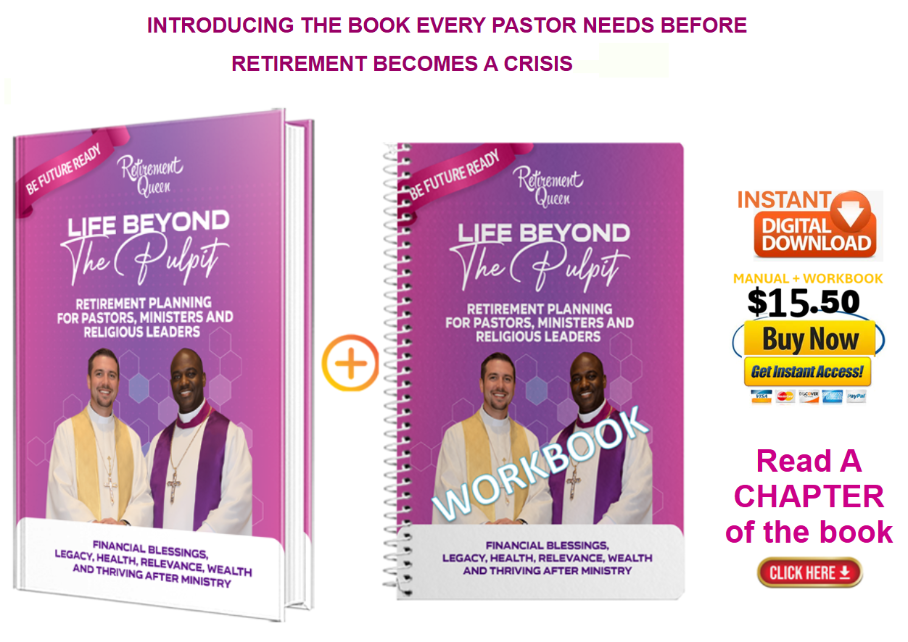
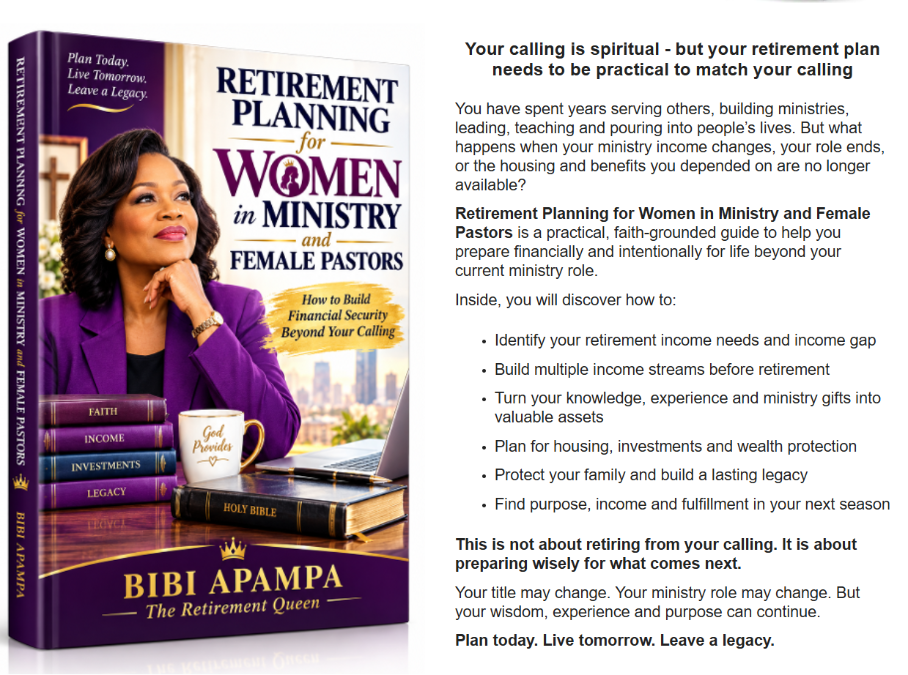
Retirement planning for pastors is different from ordinary retirement planning.
A pastor may spend 20, 30 or even 40 years serving faithfully, caring for a congregation, raising a family and answering a calling—only to discover that retirement creates a financial question that ministry did not prepare him or her to answer:
“How will I replace my ministry income when the church is no longer paying me?”
For many pastors, retirement is not simply about stopping work. It can mean losing a salary, leaving a church-owned parsonage or housing arrangement, adjusting to a different level of income, paying for healthcare and family needs, and discovering that a pension alone may not provide the lifestyle or financial security they expected.
That is why retirement planning for pastors should begin years before the final Sunday in the pulpit.
Research specifically examining clergy retirement has found that financial preparedness varies significantly according to factors such as age, years in ministry, church size and whether the minister intends to fully retire. Housing was also closely connected to financial wellbeing. The researchers concluded that clergy need retirement education specifically designed around their unique circumstances.
Research involving near-retirement pastors in Southern Africa has similarly highlighted an important issue: pastors can report high job satisfaction while still being uncertain that they have saved enough for retirement.
The answer is not to wait until retirement is close.
The answer is to build a Pastor Retirement Income Plan™ while there is still time to act.
Why Retirement Planning for Pastors Is Different
A pastor's financial life can contain several unique retirement challenges.
You may have:
- Worked for several churches during your ministry career
- Received housing through a parsonage or church-owned accommodation
- Had irregular or modest pension contributions
- Relied heavily on one ministry income
- Built little personal investment income
- Put family and ministry needs ahead of retirement savings
- Started serious retirement planning later than you intended
- Expected to continue preaching or consulting after retirement
- Accumulated skills and relationships that could generate income but have never been monetized
One of the biggest risks is confusing ministry security with retirement security.
Having a secure position today does not automatically create an income stream for tomorrow.
A pastor can be secure in the pulpit and still be financially unprepared for retirement.
The PASTOR Retirement Framework™
I recommend that pastors look at retirement through six interconnected pillars using the acronym
P-A-S-T-O-R
P — Pension
A — Accommodation
S — Sustainable Income
T — Two to Five Additional Income Streams
O — Ownership
R — Risk Protection
Let us look at the first “P” in the Pastor Retirement Framework
P — Pension
Know exactly what retirement benefits you have.
Do not simply assume that because you have a pension, you have a retirement plan.
Find out:
1. How much has been accumulated?
2. What benefits are guaranteed?
3. When can you access them?
4. What income could they realistically provide?
5. What happens to the benefits if you change churches?
6. What happens to your spouse if you die first?
7. Are there gaps in your retirement contributions?
In different countries, the National Pension Commission usually provides a regulatory framework for retirement savings, including the Personal Pension Plan for eligible self-employed people and employees of organizations with fewer than three employees. Under the Personal Pension Plan, contributors maintain a Retirement Savings Account with a licensed Pension Fund Administrator and make voluntary contributions.
Your pension is one pillar of retirement—not necessarily the entire building.
A — Accommodation
Where will you live when the church stops providing housing?
This is one of the most overlooked questions in pastoral retirement planning.
A pastor living in a church-owned home may feel financially comfortable because housing costs are relatively low during active ministry.
But retirement can change the equation dramatically.
If the pastor must leave the parsonage, the retirement budget may suddenly need to accommodate:
- Rent
- Mortgage payments
- Property taxes
- Utilities
- Maintenance
- Insurance
- Repairs
- Relocation costs
That means housing must be treated as a retirement asset and retirement expense, not merely a ministry benefit.
A useful question is:
“If I had to leave my current church accommodation tomorrow, could my retirement income comfortably pay for my next home?”
If the answer is no, housing belongs near the top of your retirement action plan.
S — Sustainable Income
Your retirement goal should not simply be:
“How much money will I have?”
A better question is:
“How much reliable income can my assets and activities produce every month?”
This distinction is crucial.
Imagine Pastor David retires with $1.5 million in accumulated assets.
That sounds impressive.
But if he has no plan for converting those assets into sustainable income, he still has a retirement-planning problem.
Now imagine another pastor has:
- Pension income
- Rental income
- Dividend or investment income
- Income from a digital product
- Speaking or consulting income
The second pastor may have greater income resilience even if the total value of his assets is not dramatically higher.
The Retirement Income Formula
Use this simple calculation:
Retirement Income Gap = Desired Monthly Retirement Income − Reliable Monthly Retirement Income
For example:
Desired retirement income: $10,000/month
Reliable pension and other income: $6,000/month
Retirement income gap:
$10,000 − $6,000 = $4,000/month
Your retirement plan must answer one question:
Where will the additional $4,000 come from?
That is much more useful than simply asking whether you have "enough savings."
T — Two to Five Additional Income Streams
Pastors should consider building income beyond their pension.
This does not mean turning ministry into a commercial enterprise.
It means recognising that decades of pastoral experience create valuable skills.
Potential retirement income streams can include:
- Christian books and eBooks
- Online courses
- Speaking
- Leadership training
- Marriage and family education
- Mentoring
- Coaching
- Consulting
- YouTube education
- Podcasts
- Digital products
- Real estate
- Dividends and investment income
- Affiliate income
- Training programmes
- Ministry resources
The goal is not to build 20 businesses.
The goal is to create two or three dependable income streams before retirement.
A pastor who starts building a $10,000 monthly income stream at age 50 has created something valuable.
A pastor who waits until age 67 to start thinking about income replacement has much less time to experiment, learn and build.
O — Ownership
One of the most important questions in retirement planning is:
What do you own?
Pastors should create an Asset Ownership Map.
List everything you own in five categories:
1. Financial assets
Savings, pensions, investments and securities.
2. Property
Land, houses, rental properties and other real estate.
3. Business assets
Businesses, partnerships and income-producing ventures.
4. Intellectual property
Books, courses, training materials, online programmes, recordings and other knowledge assets.
5. Digital assets
Websites, email lists, YouTube channels, podcasts and digital products.
The objective is to move gradually from:
“I earn because I work”
to:
“I own assets that can continue producing value and income.”
That is the foundation of retirement wealth.
R — Risk Protection
Retirement planning is not only about making money.
It is also about protecting what you have built.
Review:
- Emergency savings
- Health insurance
- Life insurance where appropriate
- Disability or income protection where applicable
- Property insurance
- Debt
- Investment risk
- Estate planning
- Wills and beneficiary designations
A pastor may spend decades building wealth and then lose much of the financial progress through one major uninsured event, excessive debt or poor estate planning.
Your retirement plan should therefore include a Protection Plan.
Legacy and Purpose
Retirement should not mean losing your identity.
For many pastors, the greatest psychological challenge is not financial.
It is answering:
“Who am I if I am no longer the senior pastor?”
A healthy retirement plan therefore includes both:
Financial Purpose
How will I fund my lifestyle?
Life Purpose
How will I continue to use my gifts, experience and influence?
A pastor may move from:
full-time pastor → mentor → author → speaker → consultant → ministry adviser
rather than moving from:
pastor → doing nothing.
Retirement can become a transition into a new season of meaningful work rather than the end of meaningful work.
The Pastor Retirement Scorecard
Before you retire, score yourself from 1 to 5 in each area:
|
Retirement Area |
Score 1–5 |
|
Pension/Savings |
___ |
|
Housing |
___ |
|
Retirement Income |
___ |
|
Additional Income Streams |
___ |
|
Investments/Assets |
___ |
|
Insurance/Protection |
___ |
|
Estate/Legacy Planning |
___ |
|
Purpose After Ministry |
___ |
Your score
32–40: Retirement Ready
You have a strong foundation but continue refining your plan.
24–31: Retirement Needs Attention
You have made progress, but important gaps remain.
16–23: Retirement Risk Zone
You should begin a focused retirement catch-up plan.
Below 16: Urgent Action Needed
Do not wait for retirement to force the conversation. Begin building your retirement plan now.
This scorecard is not a financial guarantee or regulated financial assessment. It is a practical planning tool to help identify areas requiring attention.
The 5-Step Pastor Retirement Action Plan™
Step 1: Calculate Your Retirement Number
Write down the monthly income you would ideally like to receive in retirement.
Then calculate your essential monthly expenses.
Do not guess.
Use actual numbers.
Step 2: Calculate Your Retirement Income Gap
Add together your reliable expected retirement income.
Then subtract it from your target.
Target Income − Reliable Income = Retirement Income Gap
That gap becomes the central number your retirement plan must solve.
Step 3: Audit Your Assets
Create a complete list of:
- Pension accounts
- Savings
- Investments
- Property
- Businesses
- Intellectual property
- Digital assets
Then identify which assets can eventually produce income.
Step 4: Build Two Additional Income Streams
Choose two opportunities that match your:
- Experience
- Skills
- Available time
- Capital
- Personality
- Network
For example, a pastor who has taught marriage seminars for 15 years could potentially develop a structured marriage course, book or coaching program.
A pastor with strong preaching and teaching skills could develop books, online courses or educational content.
The principle is simple:
Turn experience into assets. Turn assets into income.
Step 5: Create Your Pulpit-to-Retirement Transition Plan
Ideally, begin planning several years before retirement.
Your transition plan should answer:
When will I reduce my pastoral responsibilities?
Where will I live?
How much monthly income will I need?
Which income streams will continue after ministry?
What work will I continue doing?
What happens to my spouse if I die first?
What legacy do I want to leave?
A pastor should therefore ask:
Am I covered by a pension arrangement through my church or denomination?
If not, what retirement savings structure applies to me?
Am I making voluntary contributions where appropriate?
Have I obtained professional advice about my particular situation?
Never assume that another pastor's retirement arrangement automatically applies to you.
Your Retirement Should Not Depend on One Income Stream
One of the strongest principles I teach pastors is:
Do not build a retirement plan around a single source of income. Build an income ecosystem.
For example:
Pension + Property Income + Investment Income + Knowledge Income
creates a different level of resilience from:
Pension Alone
The objective is not necessarily to create enormous wealth.
The objective is to create financial resilience.
If one income source falls, the entire retirement plan should not collapse.
Start Before You Feel Ready
You do not need to have millions of naira, dollars, pounds or rands before you begin retirement planning.
You need a starting point.
Start by knowing:
1. What you own.
2. What you owe.
3. What you currently earn.
4. What you will need in retirement.
5. What pension income you can realistically expect.
6. What your retirement income gap is.
7. Where you will live.
8. Which additional income streams you can build.
9. How you will protect your family.
10.What you want your life to look like after full-time ministry.
Retirement planning for pastors is not about preparing to stop serving.
It is about preparing financially so that the next season of life can be entered with dignity, freedom, purpose and peace.
You have spent years preparing sermons, counselling families, building churches and serving people.
It is time to prepare for the years ahead with the same intentionality.
From Pulpit to Retirement
Your calling may continue.
Your income model may change.
Your responsibilities may change.
Your location may change.
But retirement does not have to mean financial fear.
With the right plan, you can move from pulpit to retirement with income, assets, purpose and a legacy that continues beyond your final Sunday.
Frequently Asked Questions About Retirement Planning for Pastors
When should a pastor start retirement planning?
Ideally, retirement planning should begin many years before retirement. However, it is never too late to calculate your retirement income gap, audit your assets and begin building additional income streams.
How much money does a pastor need to retire?
There is no single retirement number that applies to every pastor. The amount depends on expected lifestyle, housing costs, healthcare, family responsibilities, debt, expected pension income, other assets and longevity. A better starting point is to calculate your desired monthly retirement income and subtract reliable expected retirement income.
What happens if a pastor lives in a church parsonage?
The pastor should determine what happens to the housing arrangement at retirement. If the church-owned property must be vacated, the pastor needs a separate housing plan. Housing can be one of the most significant changes in a pastor's retirement budget.
Can a pastor create income after retirement?
Yes. Retirement can include part-time ministry, consulting, speaking, teaching, writing, digital products, coaching, property income and investment income, depending on the pastor's skills, circumstances and applicable laws.
Should pastors rely only on their pension?
A pension can be an important retirement income source, but pastors should assess whether their expected pension will cover their actual retirement needs. If there is an income gap, the gap should be addressed before retirement through additional savings, assets and/or income streams.
What should a pastor do if they started saving late?
Do not spend years regretting the late start. Calculate the gap, reduce unnecessary expenses, review debt, increase savings where possible, examine existing assets and build additional income streams. A late start requires a more deliberate plan—not abandonment of the goal.
What is the most important retirement question for a pastor?
Ask: “Where will my retirement income come from when the church is no longer my employer?”
Once you can answer that question with numbers, you can begin building a practical retirement strategy.
A Final Word from The Retirement Queen
You deserve a comprehensive pastoral retirement plan.
Serving faithfully does not mean neglecting your financial future.
Planning for retirement is not a lack of faith.
It is stewardship.
The goal is not simply to retire from the pulpit.
The goal is to enter your next season with income, assets, housing, protection, purpose and peace of mind.
Plan your retirement before retirement plans for you.
Written by Bibi Apampa,
The Retirement Queen®
Retirement Consultant | Retirement Wealth Strategist | International Keynote
Speaker | Bestselling Author
About the Author
Bibi Apampa — The Retirement Queen®
Bibi Apampa, fondly known as The Retirement Queen®, is an internationally recognized Retirement Consultant, Retirement Wealth Strategist, International Keynote Speaker, and bestselling author specializing in retirement planning, retirement income and wealth creation.
She helps professionals, executives, entrepreneurs, pastors, business owners and individuals approaching retirement prepare for a financially secure and fulfilling next chapter by developing sustainable retirement income, multiple income streams, wealth-building strategies and practical retirement plans.
Bibi is the Founder of The Retirement Queen®, CEO of Wealth Academy Africa, and creator of the Retirement Made Simple™ Framework—a practical approach designed to simplify retirement planning and help people prepare for retirement with greater confidence, purpose and peace of mind.
As a Fellow of both the Institute of Chartered Accountants and the Chartered Institute of Taxation, Bibi has trained thousands of professionals, church leaders, entrepreneurs and aspiring retirees through her books, keynote presentations, coaching programs, workshops and online training.
Her areas of expertise include retirement planning, retirement income strategies, multiple income streams, passive income, wealth creation, financial independence, retirement coaching, and retirement planning for pastors and faith leaders.
Through her work with pastors and religious leaders, Bibi focuses particularly on helping ministry leaders prepare financially for life beyond the pulpit—including retirement income, asset ownership, housing, wealth creation, additional income streams and legacy planning.
Learn
more about Bibi Apampa The Retirement Queen:
https://RetirementQueen.net
Book Bibi Apampa as an Expert Speaker
https://RetirementQueen.net/keynote-speaking.php
“Building Retirement Wealth – Today's Wealth, Future Wealth and Generational Wealth”
Bibi Apampa is available for keynote presentations, conferences, leadership events, retirement seminars, church programs and professional development events.
This article is for educational purposes and does not constitute individual financial, investment, tax or legal advice. Pension, tax, housing and retirement rules differ by country and individual circumstances. Pastors should obtain appropriate professional advice before making financial decisions